
Bell 429 Technical Analysis
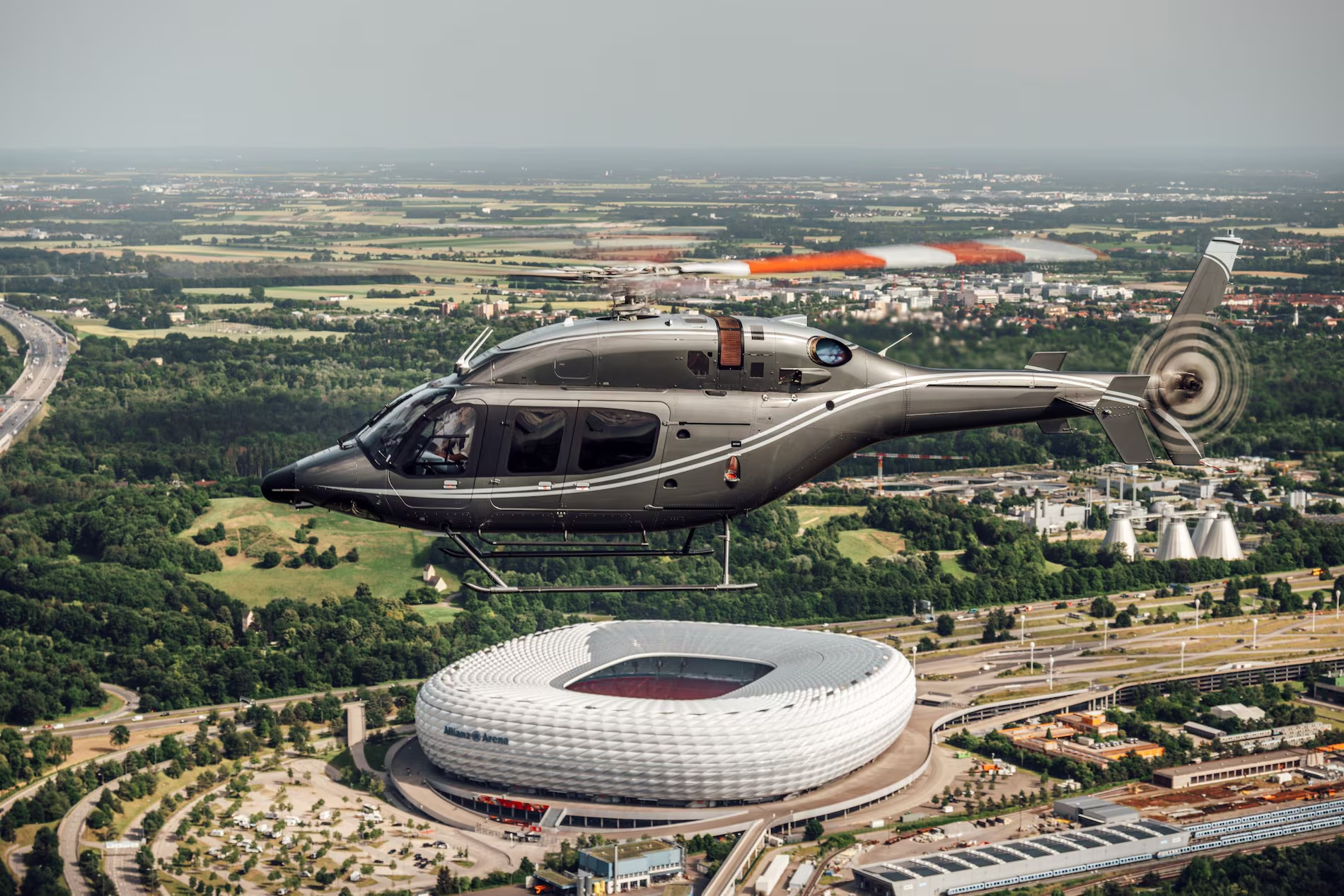
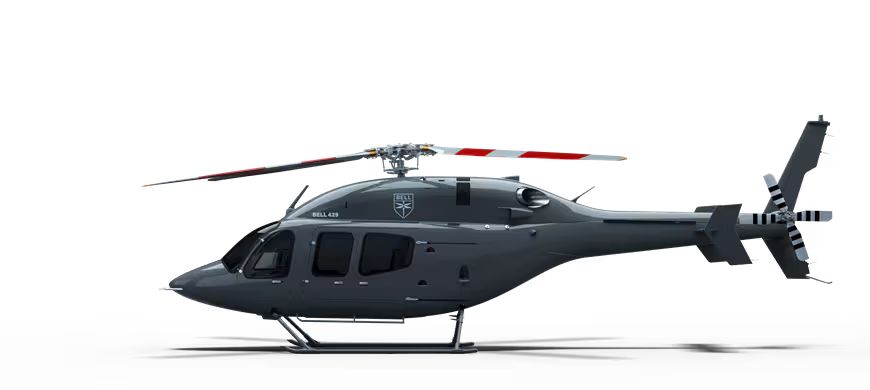
I like Bell's philosophy in the way that they design their aircraft as a pilot -- I really like that you have that confidence that the aircraft is over-prepared for what you're about to ask of it. We are in our hangar here at the Napa County airport where we keep our Bell 429, and it's a wonderful location to be our base of operations. I'm Christian Palmaz -- my family owns and operates three companies: here in California, Palmaz Vineyards in the Napa Valley, a material science company based in Silicon Valley, and also a Wagyu cattle ranch in the High Sierras called the Genesee Valley Ranch. The first time I got to experience the 429, Greg brought the aircraft down and we decided to pick a particularly challenging environment -- I knew the aircraft had a lot of power and capability, but I wanted to show the aircraft's limitations compared to our current single, and that was up at Tahoe near Truckee on a high-density-altitude, hot day. We were able to take the aircraft up there loaded to max gross weight and have impeccable control -- the aircraft did not feel like it was operating at max gross. When Christian and I first flew together, it was the middle of summer, so we had a density altitude of over 9,000 feet. We loaded to maximum gross weight, and were able to take off straight up, and then on that takeoff, using the Bell 429's OEI training mode, fly away safely, showing that the helicopter would in fact carry his family to safety in the event of a single-engine failure from that point forward. He was like, I think the 429 is the way to go. Additionally, going into mountainous environments with high winds, the aircraft handles turbulence very well -- the rotor system is very quick to adapt, and it's very nimble. The aircraft seems to be very sure-footed; it behaves like it's much lighter than it is here in the Bay Area. We don't get a lot of convective activity, but putting the aircraft in very turbulent conditions and thunderstorm environments really showed the stability and the capability of the flight director and the autopilot -- I've never seen the autopilot disengage on a 429, even in some pretty severe turbulence. The aircraft is particularly well suited for challenging IFR conditions, like you often find in San Francisco, where you're getting dumped in above the glide slope and expected to fly faster than you normally would shooting those kinds of approaches -- the flight director can handle a lot of complex situations that I've seen other flight decks struggle with. The aircraft has such excellent behavior in turbulent conditions -- the rotor system, and the way the lift mount system, the transmission and the dampers handle vibrations, really behave so well, as if the engineers had those inclement weather conditions in mind for the way these aircraft are used. The safety factor is enormous, and with the 429 you need to have that confidence in the aircraft when you're flying IFR over water -- you need to feel that the aircraft not only has that built-in redundancy, but has that built-in safety. One of the best features about the 429 is at speed -- it's so fast, and most of the time with aircraft that can go fast, you're taking a penalty in the ride, the vibration starts to pick up and the ride quality goes down, but the 429 stays smooth, and the hover speed is at 148 knots -- it's incredibly quick and efficient. Get it up to altitude and you're burning under 450 pounds an hour, and you're moving -- you're going places. Another really important feature of the aircraft is how quiet it is; we're landing in these rural environments, flying neighborly is really important. There are new regulations coming up all the time with Bay Area noise abatement procedures, and the aircraft has unique features with the split-tail design and the staggered rotor system that really allow the aircraft to have a very low noise signature given its weight class. When people bring up the tail-rotor concept versus other types of anti-torque devices, I would tell them that we very much looked at all those different anti-torque devices and found that the efficiency of the tail rotor gave us better high-altitude, hot-day capability by doing the X pattern with shorter tail-rotor blades -- it gave us the same noise signature, if not quieter, in many flight environments. Christian's mission really dictated what type of aircraft he was going to pursue -- he was looking for a twin-engine, IFR-capable helicopter large enough to fit his family; cabin space in the 429 is enormous, and the modularity of the cabin is what allows you to take a lot of stuff or people and then very quickly reconfigure the aircraft -- going from that enormous cargo area into the cabin, remove seats, reconfigure things very quickly, pull the carpet out, get to the load floor. The aircraft can be what you need it to be. I think my favorite feature about the 429 is actually that it's just so balanced -- a lot of aircraft in this segment tend to do one thing very well but sacrifice other things: maybe they can carry more but they're much slower, or they have larger cabin space but higher vibrations in flight. This aircraft's best trick is that it does all of these things really well, and at a pretty reasonable operating cost. For us, it's the confidence to be just a one-ship operator and have the support, and not feel like you're just the one-ship operator when you go and actually fly the helicopter -- that's what really drove him to the 429: the ease of handling, the ride quality, the simplicity of the systems. Those all really sealed his decision to move to the 429. I have a lot of reasons to want to stay in this family of products, and I'm excited to see what comes out next.


Interested in Bell Insights?
Get exclusive, unreleased Bell updates, videos and aircraft news before anyone else. Join the future of vertical lift, today.